
Premethos: forethought, on the record
Most forecasts are never checked. Someone says seventy per cent, the event happens or it does not, and nobody goes back to ask whether seventy per cent was a good number. Premethos is built on the opposite instinct.
It is a forecasting observatory for prediction markets. It builds its own probability for an event from primary data, prices that probability against the market, and writes the whole thing to a ledger before the outcome is known. Then it scores every forecast once the event resolves. Misses included.
Why prediction markets need an observatory
Prediction markets put a price on uncertain events, from tomorrow's high temperature in a city to a monthly jobs figure. A contract priced at 59c that pays out a dollar if the event happens is the market saying, roughly, 59 per cent.
The interesting question is whether you can do better than the market, consistently, after fees. That question can only be answered honestly with a record that nobody can rewrite. Premethos watches Kalshi and Polymarket, using them as sources of data and prices, and keeps exactly that record.
The loop: six steps, every time
Discover. It finds listed contracts with a clean official outcome and registers each one.
Forecast. It builds its own probability from primary data, with an uncertainty band around it.
Benchmark. It captures the market's bid, ask and mid at the same instant.
Decide. It subtracts the venue fee and a margin, then records no action, a watch or a paper position.
Resolve. It takes the outcome from the official source and logs the venue's own verdict beside it.
Score. It scores every forecast, and the market, the same way at the same moment.
The score feeds the next forecast. Model versions improve; history never changes.
One forecast, start to finish
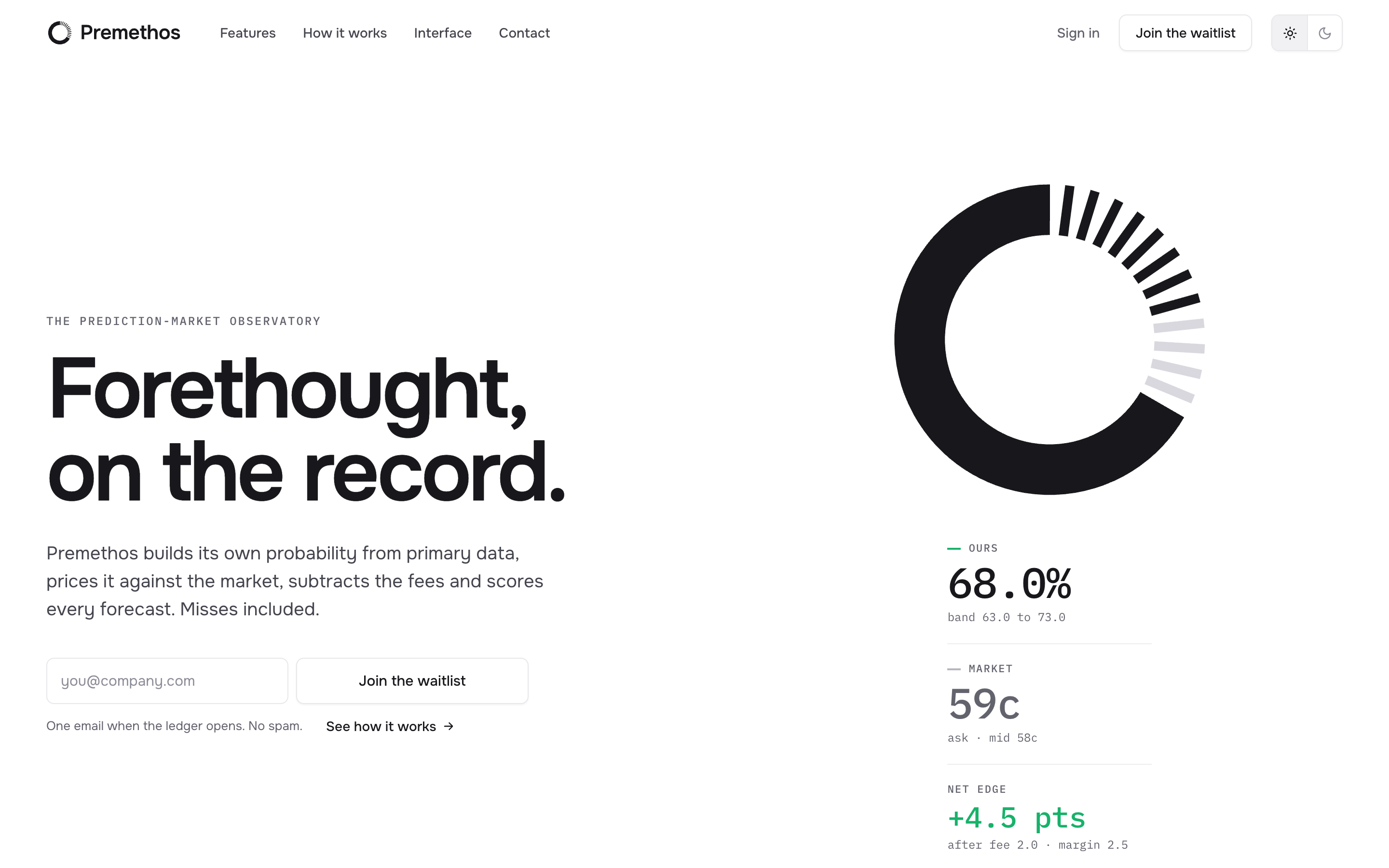
Take a real example. The question: would Miami's high on 29 September reach 88° or above? It is a listed contract, resolved by the National Weather Service daily climate report for the Miami airport station.
Premethos pooled six weather models, 225 ensemble members in all, each corrected for how it has erred at that particular station. It said 68.0 per cent. The market was asking 59c.
That is a gross edge of 9.0 points, but Premethos pays for edge before it counts it: a 2.0 point fee and a 2.5 point margin for uncertainty, leaving a net 4.5 points. That cleared its 4.0 point action threshold, so it recorded a paper position of 200 nominal.
The National Weather Service observed 89°F. The contract resolved YES, for a paper profit of 39c per contract after fees. And then the part that matters most: the forecast was scored. Premethos's Brier score was 0.102 against the market's 0.176, where lower is better.
The whole story is generated from the records, never typed, and none of it can be edited.
Built so the record cannot be flattered
An append-only ledger. Forecasts, prices, decisions and scores cannot be edited or deleted. The database itself refuses.
Fees before edge. Nothing counts as edge until the venue fee and an uncertainty margin are paid. A wider band of uncertainty raises the bar.
Resolved from the official source. Outcomes come from the primary source, such as the National Weather Service report, with the venue's verdict logged beside it.
Scored in public, misses included. Every forecast gets a Brier score and a log loss, and the market is scored the same way. The red lights stay on the record beside the green.
Graduation gates. A category of markets graduates only if it scores better than the market, shows profit with confidence, and does so in both halves of a 90-day window. Categories that fail are archived, with the reason written to the ledger.
Controls that should show nothing. Two deliberate control categories, and a leakage audit, check that the system finds no edge where none should exist.
Weather first, then nineteen more
Daily city temperature comes first, because its outcomes are clean and its primary data is rich. Behind it, nineteen further categories are ranked in waves: crypto price thresholds, US retail petrol prices and weekly jobless claims next, then music and streaming charts, sport against sharp bookmaker lines, monthly US economic releases and rain and snowfall, and later still equity index ranges and more. Every one of them has to earn its place through the same gates.
What it is, and what it is not
In this first phase Premethos records paper positions only: what it would have done, at what price and at what size. It holds no money and sends no orders. It is a forecasting and research tool, nothing it shows is a recommendation, and prediction markets are not available in every jurisdiction.
How we built it, and why that matters for yours
Premethos stands entirely on its own: its own data, its own model and its own infrastructure, with no dependency on Nexus or any other 53Alpha product while it runs. AI drafted code, tests and documentation during the build; the forecasts themselves come from its own model on primary data.
That is how we deliver client software too. A data and model-driven application built this way runs on your accounts and keeps working whether or not you use anything else we make. And the discipline carries over: when a number matters to your business, we build the system so that number can be checked.