
Nexus: one platform behind your website, your leads and your marketing
Ask a growing business how many tools sit behind its website and the answer is rarely fewer than ten: hosting, a CRM, an email tool, a booking diary, analytics, a review dashboard, a search subscription, something for social posts. None of them talk to each other, and somebody spends part of every week copying details from one to the next.
Nexus replaces that stack with one system. It hosts the site and runs the tools around it - enquiry capture and CRM, content, campaigns, bookings, reviews, search and AI-search reporting, uptime monitoring and monthly reporting - with AI doing the drafting and the checking, and a person approving.
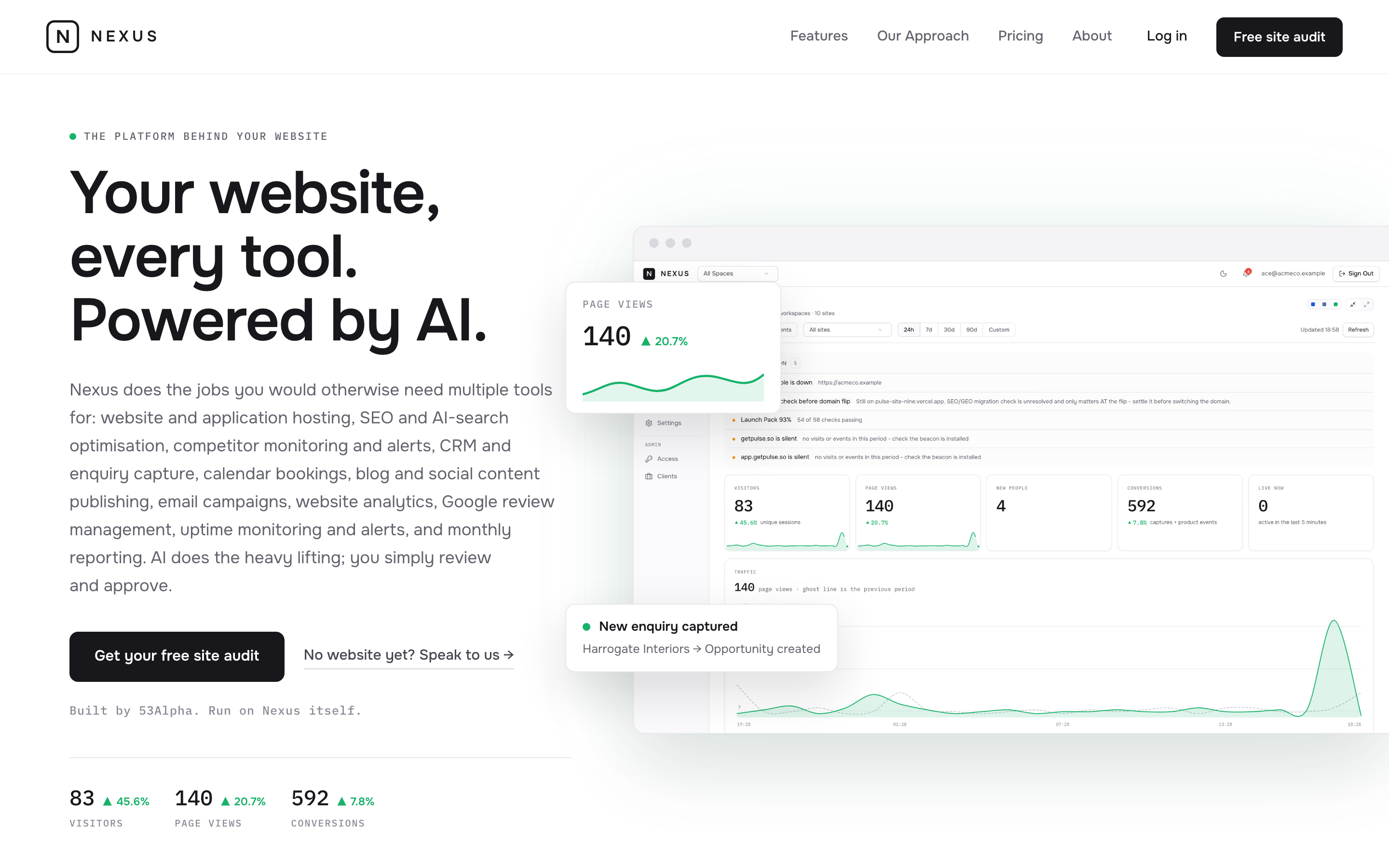
What it does
Marketing that keeps moving. AI drafts blog posts, social content and email campaigns. You approve; Nexus publishes on schedule.
Every lead in one place. The built-in CRM captures every enquiry with its source and attribution, and turns it into a tracked Opportunity. Bookings land there too, from a diary synced to Google Calendar, so every appointment sits on the customer's record.
Know what is working. Analytics, reviews, rankings and competitor activity, analysed and summarised for you.
Visible in search and in AI answers. Your Google rankings and how often AI assistants cite you, both measured continuously.
A website that is actively maintained. Uptime checked around the clock, with an alert when something goes down, and standards enforced long after launch.
You approve. Nexus operates.
The rhythm is simple. Drafts arrive in your inbox for approval and are published on schedule, so your website and your marketing keep their momentum without anyone having to remember to post. Nothing goes out without a person saying yes.
This article is an example of the loop: it was drafted, reviewed, approved and published through Nexus.
It starts with a conversation, not a template
Every site begins with a structured onboarding programme that captures the business, the brand and the objectives. One invitation creates the account. We talk through the business, its competitors and the pages it needs; the conversation is mapped onto a fourteen-step brief, and anything still missing is left blank for you to fill in. You review it, edit it and approve it.
When the brief reaches 100 per cent, it becomes the build specification: design, content and structure drawn from your own instructions rather than a theme.
Engineered, not assembled
Every Nexus site is built on Next.js and Tailwind CSS, rendered on the server from the start. That choice is what makes the rest possible: green Lighthouse performance, proper security headers, structured data on every page, an llms.txt for AI assistants, cookieless first-party analytics, enquiry capture wired straight into the CRM, and content edits that go live in seconds.
No site goes live until every section of its launch review scores 100 per cent.
The front end is not merely connected to the platform; it is part of it.
Moving without losing Google's trust
Many businesses stay on a website they have outgrown for one reason: the fear that moving will cost them years of search standing. Nexus treats that standing as something to protect.
Capture. Before anything moves, every page's metadata, structure, links and redirects are recorded as a baseline.
Port. The new site keeps your addresses or maps them one to one, carrying the metadata and structured data across. Nothing invented, nothing dropped.
Verify. After launch, every address is checked against the baseline, and nothing is signed off until it reconciles. WordPress, Wix, Squarespace and custom builds can all be moved this way.
We run on it ourselves
We run 53alpha.com on Nexus, so every module is in daily use by us before it is offered to anyone else. We offer it to clients who want hosting, a CRM or growth tooling alongside the software we build for them. It is an option, never a requirement: if you would rather run what we build on your own accounts, we hand it over.
Google Ads management is in build now, with Meta Ads and document capture planned next, each joining the same record as the enquiry it relates to.
What it shows about our client work
Platform builds, CRM and operations software, delivered as one system rather than a stack of subscriptions. Nexus was built in Claude Code, and in the product Claude drafts content, summaries and reports for a person to approve. When we build operations software for a client, that is the shape we aim for: one record, AI doing the heavy lifting, and a human making the calls that matter.